 IE Business Daily Business news for the Inland Empire.

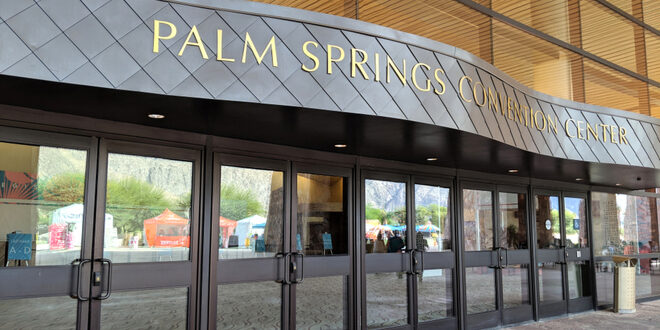
A city known around the world for its tourism wants to attract more conventions and more tourists.
The Palm Springs City Council has approved a resolution of intention to create a Tourism Improvement District that will raise money to help pay for a $135 million renovation of the Palm Springs Convention Center.
That measure passed unanimously April 8.
The proposed district, which still needs the council’s final approval, is being backed by three groups that help make up the backbone of Palm Springs’ tourist economy: P.S. Resorts, Small Hotels of Palm Springs, and Vacation Rental Owners & Neighbors of Palm Springs, known locally as VRON.
If it’s approved, the district’s main focus will be on upgrading the convention center, which was designed in the mid-1970s but did not open until 1988.
The 275,000-square-foot structure in the heart of downtown Palm Springs was last renovated in 2005, a $32 million undertaking that included a 100,000-square-foot expansion. But conventional centers have changed in 21 years, and there are more of them to compete with, so the facility needs to be brought up to modern standards.
“There are several reasons why we need to do this now,” Councilman Jeffrey Bernstein said. “A lot of maintenance upgrades need to be done in the next few years, because it’s a large building and it gets a lot of heavy use.
“It needs to be upgraded if it’s going to remain competitive, and it needs to be done relatively quickly.”
The convention center’s new general manager agrees.
“It needs a facelift, and it needs an expansion on the east side,” said Karen Totaro, who was named head of the convention center by its owner, Denver-based Oak View Group, last month. “If we do that we’ll be able to hold two conventions at once, one on the west side and one on the east side.
“That will be a game-changer, because it will bring in a lot more tourists and a lot more revenue.”
A Tourism Improvement District is a dedicated area usually formed through a public-private partnership. The revenue it generates comes from lodging businesses, and is used to help those entities, along with tourism in general.
The proposed Palm Springs district will require all of the city’s lodging businesses – large hotels, small hotels and short-term rentals, bed and breakfast’s – to collect a one percent assessment on all of its visits and hand over the revenue to the city.
That arrangement is expected to bring in about $4 million a year. Besides upgrading the convention center, revenue generated by the district will help pay for its expansion, although how large that will be has not been determined.
Owners of those businesses will continue to pay the city’s transit occupancy tax, which is 13.5 percent for hotels that host group meetings, and 11.5 percent for all other hotels, along with vacation rentals and agencies.
Most upgrades to the convention will involve the building’s infrastructure.
Right now, the east end ballroom can only be reached by walking outdoors, so an enclosure will be added between the convention center and the ballroom. Next to the ballroom, a large area that gets little use will be converted into an outdoor event space.
The convention center will also undergo a major technology upgrade.
“We don’t have the same facilities and modern amenities that other cities have,” said Kenny Cassady president of Vacation Rental Owners. “In an older convention center, people won’t find the technology that they expect to see. But if you put that kind of technology in, everything changes.
“People will spend their money, have a good time, and post on their social media how awesome things are in Palm Springs.”
If no changes are made to the convention center and its surrounding properties, the facility will likely experience about nine percent negative growth during the next five years, according to a 2023 study conducted by Conventions, Sports & Leisure International on behalf of Palm Springs.
Mid-level improvements – including the development of a hotel southwest of the convention center, and the creation of a pedestrian walkway to downtown Palm Springs – would generate approximately eight percent growth during that time, according to the study.
However, long-term improvements – development of a 350- to 400-room “headquarter” hotel near the convention center, and adding a 30,000- to 35,000-square foot ballroom, among other possibilities – could lead to nearly 30 percent economic growth during that time, the study found.
Palm Springs is losing conventions to other cities, particularly the Gaylord Pacific Resort & Convention Center in Chula Vista, said Peggy Trott, chair of P.S. Resorts, a group of hotel owners that distributes grants for local projects.
Tourism is the number one business in Palm Springs, and without the (improvement district) paying for the convention center improvements, tourism in the city will be hurt badly, said Trott, who is also general manager of the 153-room Kimpton Rowan Palm Springs Hotel,
“I want to see the convention center kept up to date,” Trott said. “That is absolutely critical. I don’t want to see any deferred maintenance, and I want to make sure we have enough money in reserve to maintain it.”
Public hearings on the district, which is proposed to last for 40 years, are scheduled to be held May 12 and May 27. If approved by the council, the district could take effect as early as July 1.

I would upgrade the present structure before adding an addition.