 IE Business Daily Business news for the Inland Empire.

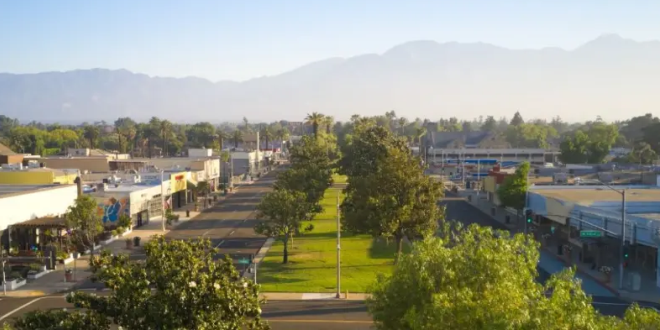
Ontario’s next step in reviving its downtown is an artistic one.
The Downtown Ontario Improvement Association and the city’s Museum, Arts & Culture Department have started a program designed to improve the appearance of storefronts along a stretch of Euclid Avenue.
“The People’s Storefront” is inviting local artists to create original works of art on vinyl that will be placed on glass storefronts along a quarter-mile of the major north-south thoroughfare, according to a statement released by the association.
That stretch, from Holt Avenue to G Street, is home to approximately 100 businesses and is considered the heart of downtown Ontario, said Ish Arias, the association’s executive director.
“It’s called the Euclid Corridor,” said Arias, who has been in charge of the nonprofit association since it was founded in 2019. “We’re going to start with six businesses, the first phase will last one year, and we’ll go from there.”
Ultimately, the association would like to see artwork all over downtown Ontario, which is bordered by Interstate 10 to the north, Holt Boulevard to the south, Lemon Avenue / Grove Avenue to the east.
Various artists will be selected to start the program, which will celebrate “creativity and local history,” along with the much-anticipated revitalization of downtown Ontario.
The right kind of artwork will increase downtown foot traffic, which can only help local retailers attract more patrons and add to their bottom lines.
“We’re using storefronts that are more or less empty right now,” Arias said. “Artwork tends to draw people people out and get their attention. It can work very well with the generation that grew up on Instagram and Facebook. People want come out and experience it more than once.”
Ontario’s downtown is ripe for the kind of artistic display that will bring people there, said Marissa Kucheck, Ontario’s director of museum, arts and culture.
“There are vacant storefronts, and this is an opportunity to beautify some of them and make them feel more alive and colorful,” Kucheck said. “It will also draw people downtown.”
Each artist will be paid up to $3,500, from funds generated by developer fees.
A study conducted one year ago by the University of Cincinnati’s College of Design and published in Cities, a journal of urban design, supports the claim that artwork, done properly, can be an economic driver for a downtown business district.
It found that city blocks with murals typically attract more than three times the foot traffic that areas without murals, or other public art displays.
Public art also increases the likelihood of spending time in an area by 50 percent, while increasing by more than 60 percent the “positive feelings” people feel towards a part of town that includes art displays, a report by Toronto Metropolitan University found.
“It’s like window shopping,” Kucheck said. “You go downtown to look at the murals but you also find a place to shop or eat.”
Ontario’s downtown overhaul began seven years ago with the formation of the improvement association. Its transit-oriented infrastructure projects are expected to be finished by 2030, according to city officials.
If all goes as planned, the multi-million dollar project will create an a “18-hour downtown” by developing civic hubs, transit infrastructure, residential units, and commercial development, most notably shops and restaurants.
Major elements include:
- A expansion of the civic center that will include a three-story building that will house various municipal departments, a parking structure and a major upgrade of Fire Station 1. That project began in 2023 and will cost $135 million;
- Six hundred housing units, widened sidewalks, and activation of the central green belt, 340-acre facility that includes recreational fields, a 5,000-seat amphitheater, and walking and biking trails;
- Converting the 1923 Bank of Italy into the Mule Car Smokehouse and the El Balcon rooftop bar. Several other historic buildings are slated for a similar conversion;
- Establishing the University of La Verne’s new College of Health and Community Well-Being next to the university’s law school at 320 E. D St.;
- A headquarters for the Ontario-Montclair School District;
- A retail “pop-up” program, which will offer short-term, affordable rents in storefronts owned by the city as a way to test the local market.
No completion date has been announced, but the downtown revitalization is already changing the look of downtown.
“It’s definitely progressing to our satisfaction,” Arias said. “We feel like the sky is the limit with this project. We’re getting restaurants, apartment buildings. We’re going to to grow, and we’re going to be where we need to be.”
Like a lot of cities, Ontario has tried for years to improve its downtown, with limited success. There weren’t enough places to live, which made it virtually impossible to attract retail, according to Councilman Alan D. Wapner.
“We always had the problem of not enough rooftops, so we ended up buying pretty much all of Euclid Avenue,” Wapner said. “We took over the street, and that gives us control of everything. We’re able to control whatever we decide to do, which is why there’s going to be a lot more housing developed downtown.”
Reviving a downtown – a difficult and expensive task under the best of circumstances – should be about more than economics, Arias believes.
“Downtown is where people do business, but it’s also a cultural core, no matter the size of the city,” Arias said. “People congregate there, and it gives a city its identity. That’s why it’s pivotal that Ontario gets this right.”

As a long time resident of Ontario and living not too far from this district I would like to see an array of various restaurants and also some chain restaurants that will bring the younger crowd in as well. We should look at Old town Pasadena and also other old town districts that keep the old charm with bricks and modern elements. We do not need anymore barber shops . there are too many in this area already.
The building of 600 apartments could be concerning and where they place them. Will they be low income, section 8 . Are we going to have another LA filled with gangs