 IE Business Daily Business news for the Inland Empire.

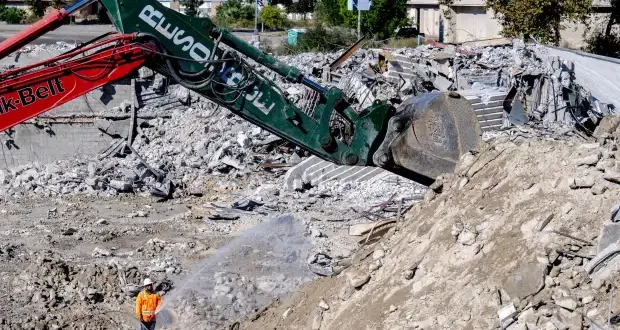
The project that will determine much of San Bernardino’s economic future is unofficially on hold, and it may stay that way for a while.
That is, how to develop the 43-acre site that was home to the Carousel Mall for more than 50 years, before it became a symbol of the decline of San Bernardino’s downtown.
San Bernardino officials have made it clear that they want office, residential, and retail built on the parcel immediately east of Interstate 215. They believe that a mixed-use development of that kind will draw people downtown to work and shop, something that hasn’t happened in years.
But no plans have been drawn up, and the city needs to find a developer, having parted company with the project’s first developer, Renaissance Downtowns USA and ICO Real Estate Group, which it hired in 2021.
That action prompted the development group to file a breach of contract lawsuit against San Bernardino in 2024. The lawsuit alleges that San Bernardino terminated the development agreement unfairly and without cause. As a result, Renaissance/ICO suffered severe financial hardship.
Eventually, San Bernardino paid Renaissance/ICO $100,000 to get out of the agreement, but the lawsuit is still considered active.
Redevelopment of the mall site also ran afoul of state law, further slowing the city’s efforts, although that matter did not end up in court.
In 2023, the California Department of Housing and Community Development accused San Bernardino of violating several state laws when it drew up its first preliminary redevelopment plans, most notably the Surplus Land Act.
That act requires that cities and counties, when disposing of surplus land, set aside some of that property for affordable housing. Also, before selling or leasing, agencies must follow certain guidelines: identify surplus land, notify affordable housing providers about the available property, and submit notices to the department.
In 2023, the department declared that San Bernardino began negotiating selling public property – the former mall site – without having formally declared it “surplus,” and that it did not tell any affordable housing developers about the available land.
The city must still clear several other hurdles before anything can be built on the former mall site, starting with finding a master developer to replace Renaissance/ICO. The property between 2nd and 4th streets must also be brought into compliance with the California Environmental Quality Act, a process that can be long, difficult and expensive.
But making certain the city is in full compliance with the Surplus Land Act, especially regarding its provisions about affordable housing, is probably San Bernardino’s highest priority now, according to Councilman Theodore Sanchez.
“We still have to set aside land, we just have to figure out how much,” said Sanchez, who represents the first district, home of the former mall site. “It’s living legislation, meaning it’s constantly changing, adjusted, and being amended. We hope to bring on a couple of experts that we can contract with, and they will help us get through that process, and get the most out of the property.”
San Bernardino must also resolve the Renaissance/ICO lawsuit, which – along with the Surplus Land Act – has had as much to do with blocking the city’s redevelopment plans as anything.
“The litigation is what’s slowing us down right,” Sanchez said. “We’re trying to close the case and get it out of the courts, but we haven’t been able to do that. Until we do it’s going to stay bogged down.”
What became the San Bernardino’s biggest headache started in 1972 as the Central City Mall. It had three anchor tenants – Montgomery Ward, The Harris Company, and JCPenney – and more than 50 specialty stores.
The two-story shopping facility underwent a major renovation in 1991, and changed its name when a carousel was installed on its lower level. Despite the overhaul, the property went into a slow decline in the early 1990s, losing tenants, falling into disrepair and becoming a gathering place for gangs.
It was also hurt by competition from Inland Center, San Bernardino’s other regional shopping mall, which opened in 1966. Only 17 stores remained when Carousel Mall was demolished in 2023. The site has been vacant since then.
Although not unprecedented, the former mall property presents a rare opportunity for a developer. It’s rare that such a large commercial parcel becomes available in the heart of a large city. But because of the legal and environmental issues the city is having to deal with, the property is not generating much interest among developers.
“As far as seeing steel go into the ground and buildings being built, that’s at least three to five years away, maybe longer,” Sanchez said. “There’s no way we start building anything sooner than that, which is unfortunate. But a downtown project as large as this one takes a long time to build.”
The city’s mixed-use approach to reviving the mall property is a good one, but it must improve the way it does business if it’s going to make that idea a reality, said Alan Stanly, the owner of several commercial buildings in downtown San Bernardino.
“The city seems to be going for a live-work scenario, and that’s not a bad approach,” Stanly said. “But the city council and the planning department are ineffective and slow, I hear that all of the time from people who are trying to do business in San Bernardino. It’s so difficult it’s not worth trying.”